The promise and perils of rapidly advancing artificial intelligence — a technology reshaping how we think, learn, work, and live — took center stage at UC Riverside's first AI Summit on October 15.
The daylong event brought together UCR administrators, faculty, students, and industry leaders to explore AI's extraordinary potential to accelerate scientific discoveries, tackle complex problems and perhaps even help find a cure for cancer.
But discussions also confronted the technology's darker possibilities, including threats to privacy, security, and critical infrastructure, as well as concerns about how AI is changing the way students learn.
"We are here today to explore possibilities — the many ways artificial intelligence could bring about a profound transformation," Chancellor S. Jack Hu said in his opening remarks.
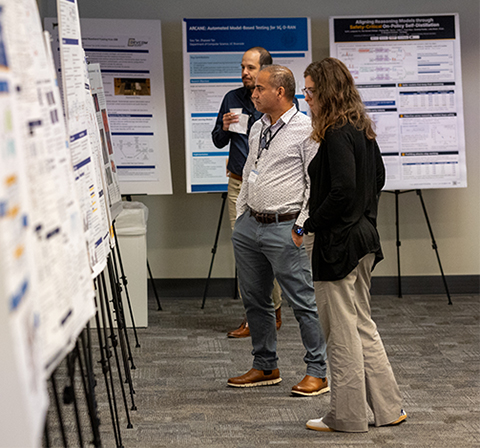
Hu pointed to advances already underway, including researchers using 37,000 AI agents to analyze 50,000 clinical trials in a single week. He also cited AI systems that detect wildfires and help recover ancient texts previously thought unreadable.
Yet he cautioned against placing too much trust in the technology.
"AI is no longer just generating answers. Increasingly, it can take action," Hu said. "As its capabilities expand, so does the importance of human judgment."
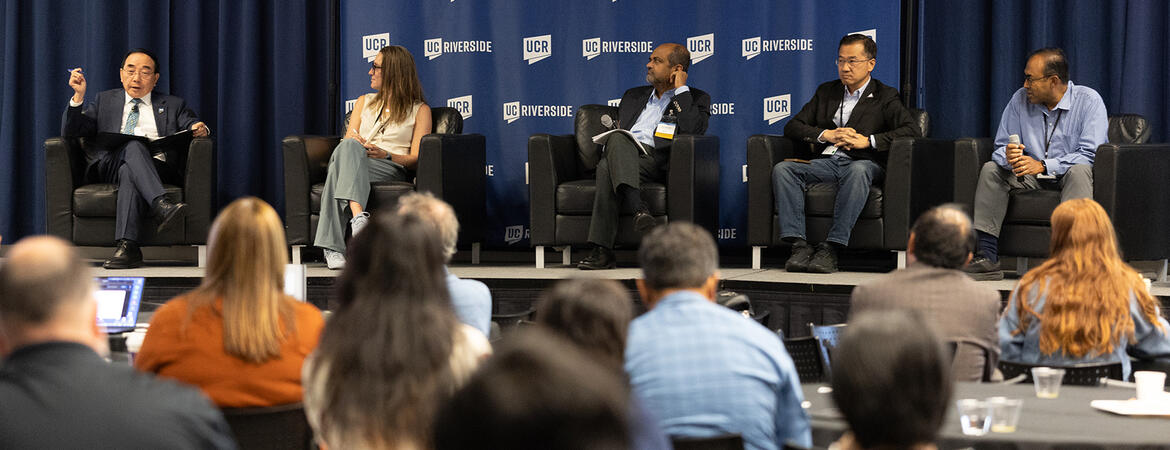
Hu later moderated a fireside discussion with four panelists representing academia, technology investment and scientific research. Their conversation explored what makes AI different from earlier technological revolutions and how universities should respond.
Alejandra Dubcovsky, a UCR history professor, chair of the UCR AI Council, and special adviser for the program on AI, said fears about technological change are hardly new. What distinguishes AI is the speed of its development and its ability to produce information once largely controlled by trained professionals.
She challenged the notion that AI's development and adoption are inevitable and beyond public influence.
"When we're told that something is inevitable, the humanities teach us to ask, who is saying that? Who benefits from that inevitability?" Dubcovsky said.
Chuck Ng, an entrepreneur, technology investor, and co-founder of the Foundation for Science and AI Research, emphasized collaboration among universities, industry, and investors to accelerate discoveries and turn research into practical benefits.
Ng suggested AI could dramatically shorten the time needed to solve difficult scientific problems, including cancer. He also proposed developing a regional AI innovation hub in Southern California, with UCR playing a leadership role.
Amit Roy-Chowdhury, a UCR professor of electrical and computer engineering and co-director of the Riverside Artificial Intelligence Research and Education Institute, known as RAISE@UCR, said AI's widespread accessibility distinguishes it from earlier inventions and creates both opportunities and risks.
He urged universities to ensure that students in every discipline understand the technology, while recognizing that an English major's educational needs differ from those of a computer scientist.
Gaurav Sukhatme, interim dean of USC's Viterbi School of Engineering and director of the USC Stevens School of Computing and Artificial Intelligence, argued that AI is challenging fundamental assumptions about human intelligence and achievement.
He proposed making AI education a general education requirement for all university students, regardless of major.
Dubcovsky agreed that students need AI literacy but emphasized that they also need foundational knowledge to evaluate AI-generated information and recognize its limitations. She warned against allowing unequal access to the technology, which she said would deepen existing educational disparities.
The discussion returned repeatedly to the importance of human judgment.
Hu said universities must prepare students not merely to use AI tools but to question their outputs, recognize errors, and make informed decisions.
"Our goal is not simply to understand and use AI," Hu said. "Our goal is to shape how AI serves humanity."
UCR is making a substantial investment in AI research, added Rodolfo H. Torres, vice chancellor for Research, Innovation and Economic Development. The university's RAISE brings together more than 100 faculty experts from all seven of UCR's colleges and schools, representing approximately 10% of the university's faculty.
The conference was organized by UCR AI Council, the RAISE Institute, and UCR’s Office of Research, Innovation, and Economic Development.